


A time for reflection (13.01.2026)

Forget the New Year Resolutions… just do some reflecting instead.
I dislike new year resolutions. There are so many things I need to change in my life that I can’t choose between them. And when I’ve tried in the past, I failed because I couldn’t hold the intention long enough to merit the effort.
Still, I do try to reflect on my life: the things that have happened over the year and the person I’ve become. It requires honesty, and it isn’t always comfortable. It is also remarkably difficult to do. I’m blind to many aspects of my life, and I can’t easily measure the consequences of my words and actions.
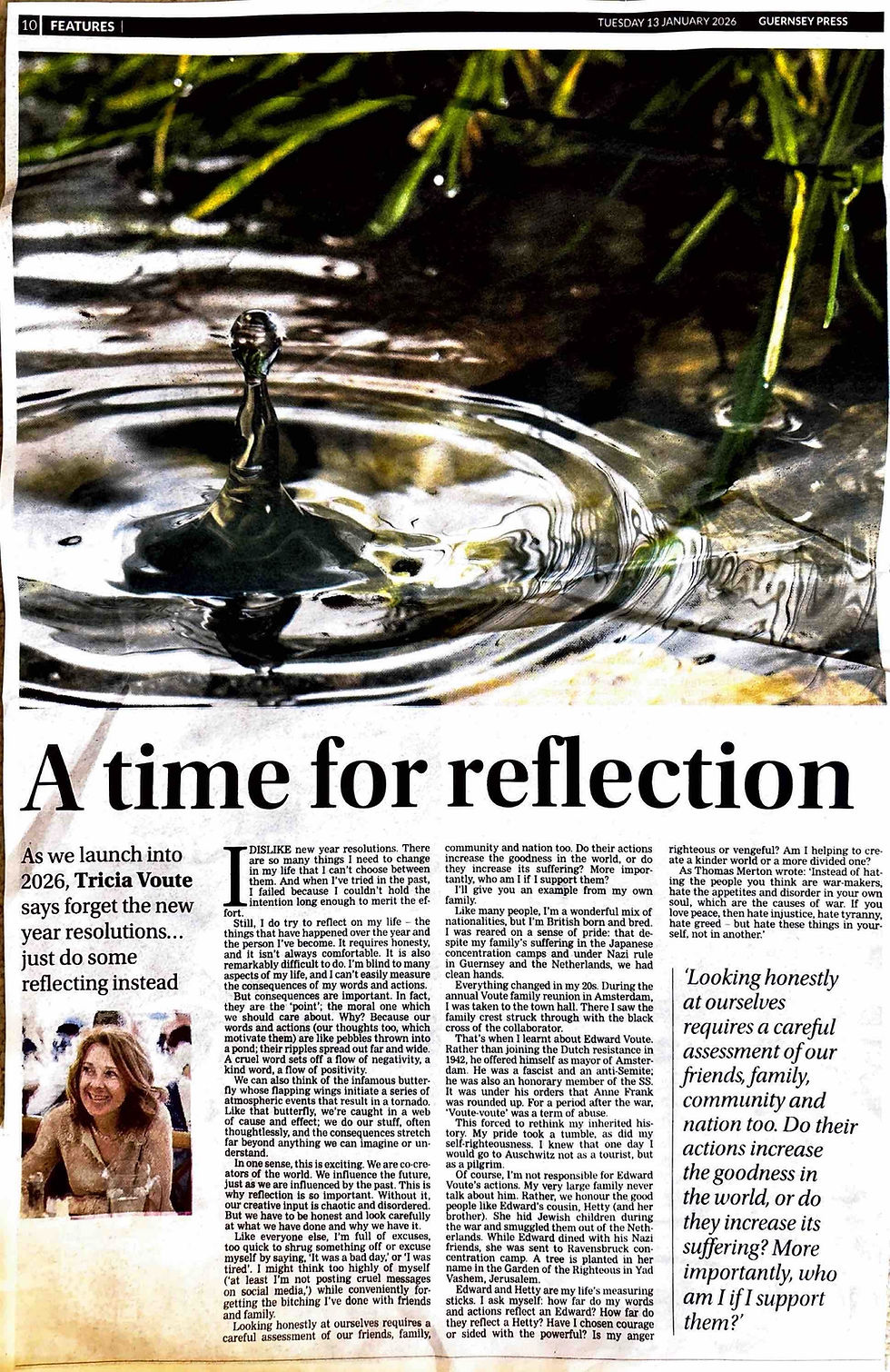
But consequences are important. In fact, they are the ‘point’; the moral one which we should care about. Why? Because our words and actions (our thoughts too, which motivate them) are like pebbles thrown into a pond; their ripples spread out far and wide. A cruel word sets off a flow of negativity, a kind word, a flow of positivity.
We can also think of the infamous butterfly whose flapping wings initiate a series of atmospheric events that result in a tornado. Like that butterfly, we’re caught in a web of cause and effect; we do our stuff, often thoughtlessly, and the consequences stretch far beyond anything we can imagine or understand.
In one sense, this is exciting. We are co-creators of the world. We influence the future, just as we are influenced by the past. This is why reflection is so important. Without it, our creative input is chaotic and disordered. But we have to be honest and look carefully at what we have done and why we have it.
Like everyone else, I’m full of excuses, too quick to shrug something off or excuse myself by saying, ‘it was a bad day,’ or ‘I was tired’. I might think too highly of myself (‘at least I’m not posting cruel messages on social media,’) while conveniently forgetting the bitching I’ve done with friends and family.
Looking honestly at ourselves requires a careful assessment of our friends, family, community and nation too. Do their actions increase the goodness in the world, or do they increase its suffering? More importantly, who am I if I support them?
I’ll give you an example from my own family.
Like many people, I’m a wonderful mix of nationalities, but I’m British born and bred. I was reared on a sense of pride: that despite my family’s suffering in the Japanese concentration camps and under Nazi rule in Guernsey and the Netherlands, we had clean hands.
Everything changed in my twenties. During the annual Voûte-family reunion in Amsterdam, I was taken to the Town Hall. There I saw the family crest struck through with the black cross of the collaborator.
That’s when I learnt about Edward Voûte. Rather than joining the Dutch resistance in 1942, he offered himself as Mayor of Amsterdam. He was a fascist and an anti-Semite; he was also an honorary member of the SS. It was under his orders that Anne Frank was rounded up. For a period after the war, ‘Voûte-voûte’ was a term of abuse.
This forced to rethink my inherited history. My pride took a tumble, as did my self-righteousness. I knew that one day I would go to Auschwitz not as a tourist but as a pilgrim.
Of course, I’m not responsible for Edward Voûte’s actions. My very large family never talk about him. Rather, we honour the good people like Edward’s cousin, Hetty (and her brother). She hid Jewish children during the war and smuggled them out of the Netherlands. While Edward dined with his Nazi friends, she was sent to Ravensbrück concentration camp. A tree is planted in her name in the Garden of the Righteous in Yad Vashem, Jerusalem.
Edward and Hetty are my life’s measuring sticks. I ask myself: how far do my words and actions reflect an Edward? How far do they reflect a Hetty? Have I chosen courage or sided with the powerful? Is my anger righteous or vengeful? Am I helping to create a kinder world or a more divided one?
As Thomas Merton wrote, “Instead of hating the people you think are war-makers, hate the appetites and disorder in your own soul, which are the causes of war. If you love peace, then hate injustice, hate tyranny, hate greed - but hate these things in yourself, not in another.”



Comments