


Why Should I Bother Listening to Others? (21.04.2026)

I keep hearing from political commentators how they have misjudged the Iranian response to the bombing just as they misjudged the invasions of Iraq and Afghanistan, the Vietnam War and the Cuban crisis. I also hear from experts that a modicum of understanding would have mitigated against this.
There are many reasons of course, from a Western-centric world view to many ambassadors being political appointees without the requisite language or understanding of the host-country.
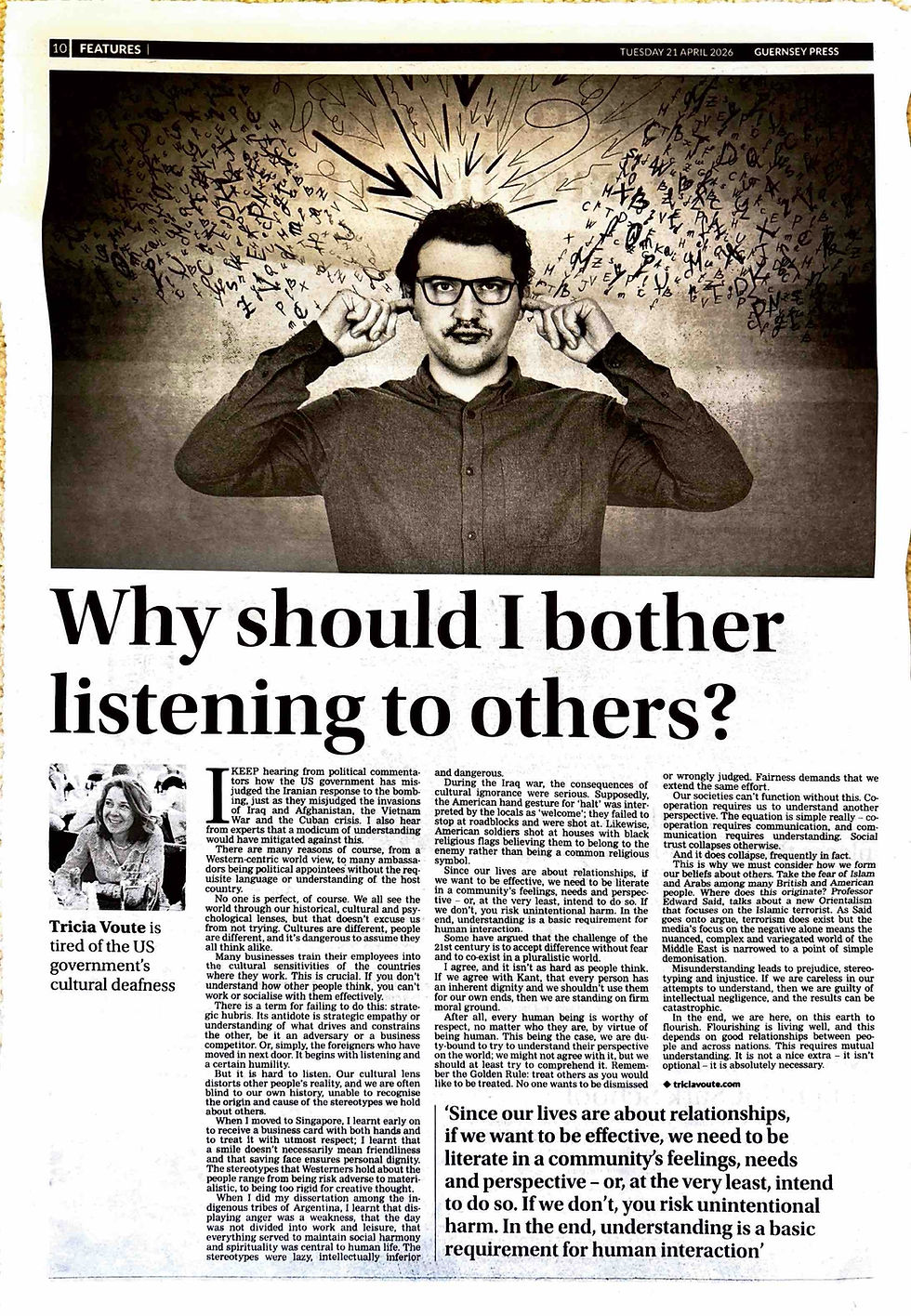
No one is perfect, of course. We all see the world through our historical, cultural and psychological lenses, but that doesn’t excuse us from not trying. Cultures are different, people are different, and it’s dangerous to assume they all think alike.
Many businesses train their employees into the cultural sensitivities of the countries where they work. This is crucial. If you don’t understand how other people think, you can’t work or socialize with them effectively.
There is a term for failing to do this: strategic hubris. Its antidote is strategic empathy or understanding of what drives and constrains the other, be it an adversary or a business competitor. Or, simply, the foreigners who have moved in next door. It begins with listening and a certain humility.
But it is hard to listen. Our cultural lens distorts other people’s reality, and we are often blind to our own history, unable to recognise the origin and cause of the stereotypes we hold about others.
When I moved to Singapore, I learnt early on to receive a business card with both hands and to treat it with utmost respect; I learnt that a smile doesn’t necessarily mean friendliness and that saving face ensures personal dignity. The stereotypes Westerners hold about the people range from being risk adverse to materialistic, to being too rigid for creative thought.
When I did my dissertation amongst the indigenous tribes of Argentina, I learnt that displaying anger was a weakness, that the day was not divided into work and leisure, that everything served to maintain social harmony and spirituality was central to human life. The stereotypes were lazy, intellectually inferior and dangerous.
During the Iraq war, the consequences of cultural ignorance were serious. Supposedly, the American hand gesture for ‘halt’ was interpreted by the locals as ‘welcome’; they failed to stop at roadblocks and were shot at. Likewise, American soldiers shot at houses with black religious flags believing them to belong to the enemy rather than being a common religious symbol.
Since our lives are about relationships, if we want to be effective, we need to be literate in a community’s feelings, needs and perspective – or, at the very least, intend to do so. If we don’t, we risk unintentional harm. In the end, understanding is a basic requirement for human interaction.
Some have argued that the challenge of the 21st century is to accept difference without fear and to co-exist in a pluralistic world.
I agree, and it isn’t as hard as people think. If we agree with Kant, that every person has an inherent dignity and we shouldn’t use them for our own ends, then we are standing on firm moral ground.
After all, every human being is worthy of respect, no matter who they are, by virtue of being human. This being the case, we are duty-bound to try to understand their perspective on the world; we might not agree with it, but we should at least try to comprehend it. Remember the Golden Rule: treat others as you would like to be treated. No one wants to be dismissed or wrongly judged. Fairness demands that we extend the same effort.
Our societies can’t function without this. Cooperation requires us to understand another perspective. The equation is simple really: cooperation requires communication, and communication requires understanding. Social trust collapses otherwise.
And it does collapse, frequently in fact.
This is why we must consider how we form our beliefs about others. Take the fear of Islam and Arabs amongst many British and American people. Where does this originate? Professor Edward Said, talks about a new Orientalism that focuses on the Islamic terrorist. As Said goes onto argue, terrorism does exist but the media’s focus on the negative alone means the nuanced, complex and variegated world of the Middle East is narrowed to a point of simple demonisation.
Misunderstanding leads to prejudice, stereotyping and injustice. If we are careless in our attempts to understand, then we are guilty of intellectual negligence, and the results can be catastrophic.
In the end, we are here, on this earth to flourish. Flourishing is living well, and this depends on good relationships between people and across nations. This requires mutual understanding. It is not a nice extra – it isn’t optional – it is absolutely necessary.



Comments