


Advent and the art of waiting (16.12.2025)
- Tricia Voute
- Apr 14
- 3 min read

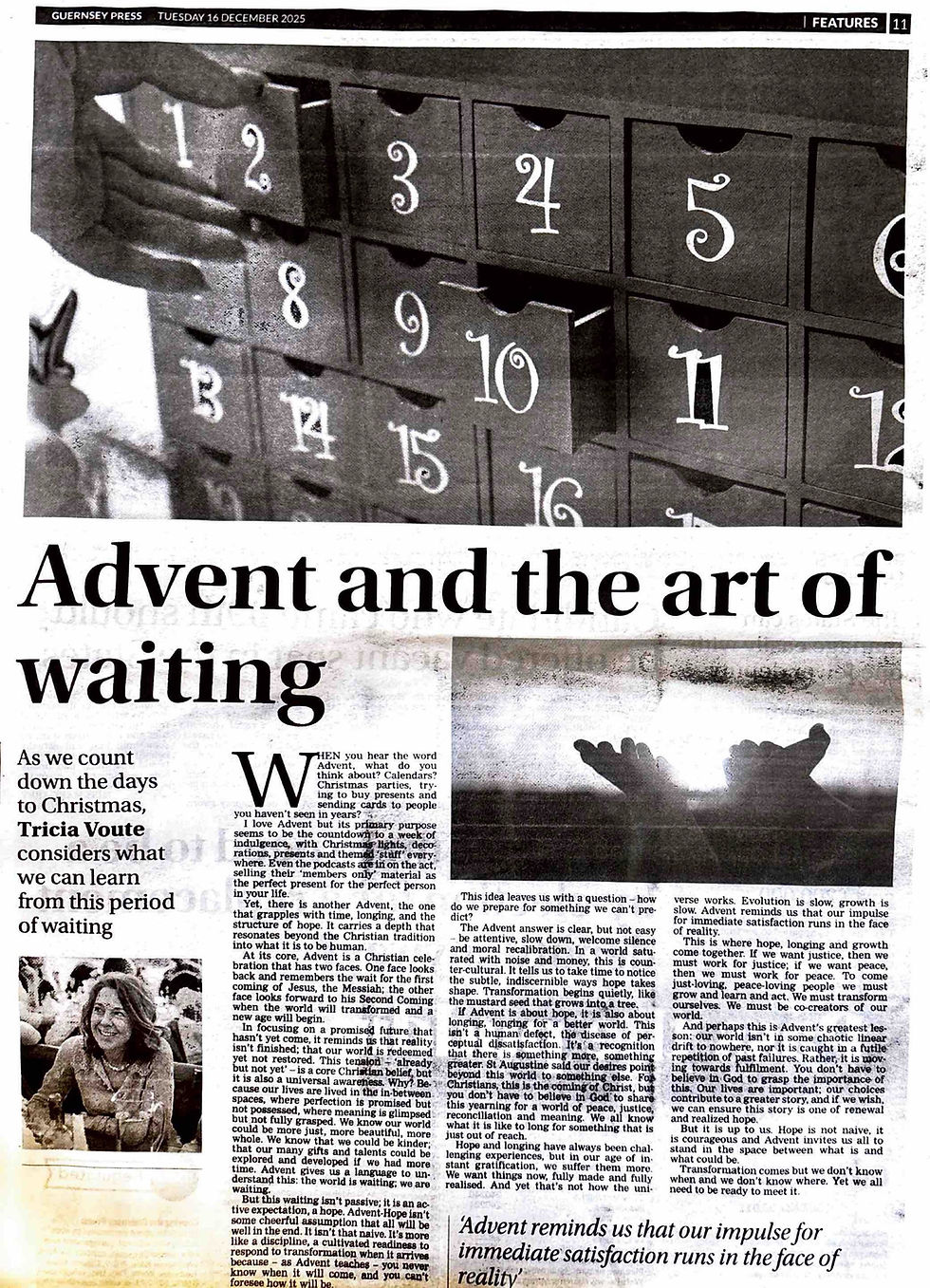
Advent and art of waiting
When you hear the word Advent, what do you think about? Calendars? Christmas parties, trying to buy presents and sending cards to people you haven’t seen in years?
I love Advent but its primary purpose seems to be the countdown to a week of indulgence, with Christmas lights, Christmas decorations, presents and themed ‘stuff’ everywhere. Even the podcasts are in on the act, selling their ‘members only’ material as the perfect present for the perfect person in your life.
Yet, there is Another Advent, the one that grapples with time, longing, and the structure of hope. It carries a depth that resonates beyond the Christian tradition into what it is to be human.
At its core, Advent is a Christian celebration that has two faces. One face looks back and remembers the wait for the first coming of Jesus, the Messiah; the other face looks forward to his Second Coming when the world will transformed and a new age will begin.
In focusing on a promised future that hasn’t yet come, it reminds us that reality isn’t finished; that our world is redeemed yet not restored. This tension—“already but not yet”—is a core Christian belief, but it is also a universal awareness. Why? Because our lives are lived in the in-between spaces, where perfection is promised but not possessed,
where meaning is glimpsed but not fully grasped. We know our world could be more just, more beautiful, more whole. We know that we could be kinder; that our many gifts and talents could be explored and developed if we had more time. Advent gives us a language to understand this: the world is waiting; we are waiting.
But this waiting isn’t passive; it is an active expectation, a hope. Advent-Hope isn’t some cheerful assumption that all will be well in the end. It isn’t that naïve. It’s more like a discipline, a cultivated readiness to respond to transformation when it arrives because – as Advent teaches – you never know when it will come, and you can’t foresee how it will be.
This idea leaves us with a question: how do we prepare for something we can’t predict?
The Advent answer is clear, but not easy: be attentive, slow down, welcome silence and moral recalibration. In a world saturated with noise and money, this is countercultural. It tells us to take time to notice the subtle, indiscernible ways hope takes shape.
Transformation begins quietly, like the mustard seed that grows into a tree.
If Advent is about hope, it is also about longing, longing for a better world. This isn’t a human defect, the disease of perceptual dissatisfaction. It’s a recognition that there is something more, something greater. St Augustine said our desires point beyond this world to something else. For Christians, this is the coming of Christ, but you don’t have to believe in God to share this yearning for a world of peace, justice, reconciliation and meaning. We all know what it is like to long for something that is just out of reach.
Hope and longing have always been challenging experiences, but in our age of instant gratification, we suffer them more. We want things now, fully made and fully realized. And yet that’s not how the universe works. Evolution is slow, growth is slow. Advent reminds us that our impulse for immediate satisfaction runs in the face of reality.
This where hope, longing and growth come together. If we want justice, then we must work for justice; if we want peace, then we must work for peace. To come just-loving, peace-loving people we must grow and learn and act. We must transform ourselves. We must be co-creators of our world.
And perhaps this is Advent’s greatest lesson: our world isn’t in some chaotic linear drift to nowhere, nor it is caught in a futile repetition of past failures. Rather, it is moving towards fulfilment. You don’t have to believe in God to grasp the importance of this. Our lives are important; our choices contribute to a greater story, and if we wish, we can ensure this story is one of renewal and realised hope.
But it is up to us. Hope is not naïve, it is courageous and Advent invites us all to stand in the space between what is and what could be. Transformation comes but we don’t know when and we don’t know where. Yet we all need to be ready to meet it.



Comments